Home ›
Guides › Foods That Support Healthy Blood Sugar
Foods That Support Healthy Blood Sugar
By the KissMyAbsClub Editorial Team
•Health Is Power Foundation
•Fact-checked against cited sources · July 2026
See how your everyday meals stack up. Take our free 2-minute blood sugar quiz for a personalised learning plan.
Take the free quiz →
The short version:
- The most reliable pattern is fibre-rich whole plants — vegetables, legumes, whole grains, fruit, nuts, and seeds.
- Pairing carbohydrate with protein and healthy fat is associated with a gentler rise in blood sugar than carbohydrate alone.
- Choose whole over refined carbohydrate most of the time — the fibre changes how the food is digested.
- Habits like "fibre first" and mostly-water hydration are simple, low-risk experiments. This is education, not medical advice.
If you search "foods for blood sugar," you'll drown in miracle lists and things to "never eat again." The reality is calmer and far more doable. No single food controls blood sugar, and none is truly forbidden. What the research points to instead is a pattern of eating that's associated with steadier blood sugar across large groups of people.1 This guide translates that pattern into an everyday plate — strictly as general wellness education, not a plan to treat any condition.
1. Fibre-rich plants (the foundation)
Fibre is the quiet hero of steady blood sugar. Because your body doesn't rapidly break it down, fibre slows how quickly a meal is digested, softening the rise in glucose that follows. It also feeds the gut bacteria that produce helpful metabolic compounds — a link we explore in our companion article on how your gut affects blood sugar. Foods to lean on:
- Non-starchy vegetables — leafy greens, broccoli, peppers, courgette, tomatoes, onions.
- Legumes — beans, lentils, and chickpeas, which pair fibre with protein.
- Whole grains — oats, barley, brown rice, and whole-grain bread instead of their refined versions.
- Whole fruit — berries, apples, pears, and citrus, eaten whole rather than juiced.
- Nuts and seeds — a handful adds fibre, protein, and healthy fat.
Diets higher in fibre are consistently associated with better long-term metabolic markers in the general population.2 If you're starting from a low-fibre diet, raise it gradually and drink enough water; our fibre guide covers how to ramp up comfortably.
2. Protein and healthy fat as partners
Carbohydrate rarely arrives alone in a real meal, and that's a good thing. Adding protein and healthy fat to a plate is associated with a gentler blood sugar response than eating carbohydrate on its own, partly because the meal digests more slowly and feels more satisfying. Easy building blocks include eggs, fish, poultry, tofu and tempeh, plain yogurt, beans, olive oil, avocado, nuts, and seeds. The idea isn't to fear carbohydrate — it's to give it company.
3. Whole vs refined carbohydrates
This is where the biggest, simplest wins live. Whole carbohydrates come wrapped in fibre and are digested more gradually; refined ones have had much of that fibre stripped away, so they tend to hit faster. You don't need to eliminate anything — just shift the balance:
- White rice → brown rice, or mix the two.
- White bread → dense whole-grain or seeded bread.
- Sugary breakfast cereal → oats or plain yogurt with fruit and nuts.
- Fruit juice → whole fruit, which keeps its fibre.
Not sure where to start? Take our free 2-minute quiz to see how your habits relate to blood sugar and get a plain-English plan matched to you.
4. The "fibre first" idea
Here's a small habit that's easy to test: at a meal with carbohydrate, eat the fibre-rich vegetables and the protein first, and save the starchier or sweeter parts for a little later. Some small studies suggest that meal order is associated with a gentler rise in blood sugar afterwards.3 It costs nothing, doesn't require giving anything up, and is worth a try — though, like everything here, results vary from person to person and it isn't a treatment for any condition.
5. What to drink
Drinks are an easy place for sugar to sneak in. The steadiest choice is unglamorous: water, most of the time. Unsweetened tea and coffee are fine for most people, and if you enjoy something with flavour, sparkling water with a squeeze of citrus does the job. Sugary sodas and large glasses of juice deliver fast-acting sugar with little fibre to slow it down, so they're best treated as occasional rather than everyday.
Putting it on a plate
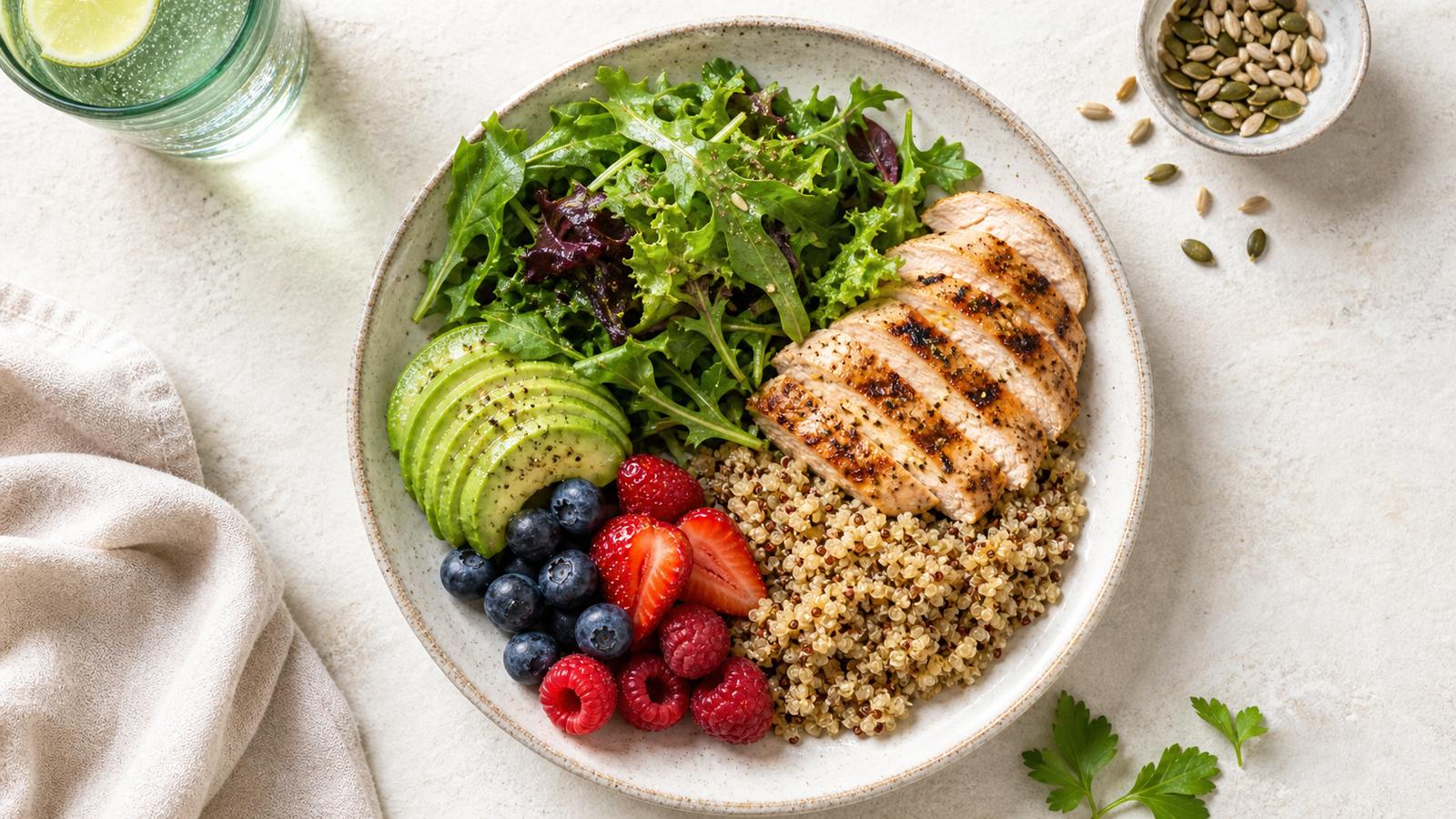
A useful mental model — echoed by public-health guidance — is to picture your plate roughly as: half non-starchy vegetables, a quarter protein, and a quarter whole-grain or starchy carbohydrate, with some healthy fat for flavour and satisfaction.1 A few real examples:
- Lunch: a big salad with chickpeas or grilled chicken, olive oil, and a slice of whole-grain bread.
- Dinner: salmon or tofu, roasted vegetables, and a modest scoop of brown rice or quinoa.
- Breakfast: oats with plain yogurt, berries, and a spoon of nuts or seeds.
- Snack: an apple with a handful of almonds, or hummus with vegetable sticks.
Notice the theme: fibre, protein, and healthy fat show up together, and whole foods do most of the heavy lifting. It's the same plate that supports a healthy gut, which is why our best foods for gut health guide reads so similarly.
A calm word on expectations
These habits are about supporting steady blood sugar as part of general healthy eating — not treating, curing, or managing any medical condition. If you have symptoms, a family history, or an existing diagnosis, blood sugar is something to review with a qualified clinician who can test properly and give advice tailored to you. Food is one helpful piece of a bigger picture that also includes movement, sleep, and professional care.
Reviewed by the Health Is Power Foundation editorial team.
We check each article against authoritative sources before publishing and update it as the evidence changes. Last reviewed July 2026.
Frequently asked questions
- What foods are associated with steady blood sugar?
- Fibre-rich whole plant foods are the most consistent pattern: vegetables, legumes, whole grains, fruit, nuts, and seeds. Pairing carbohydrate with protein and healthy fat, and choosing whole over refined carbohydrate, is also associated with gentler responses. This is general education, not medical advice.
- Does the order you eat food in matter?
- Some small studies suggest eating fibre-rich vegetables and protein before refined carbohydrate is associated with a gentler rise in blood sugar. It's a low-risk habit to try, though results vary and it isn't a treatment for any condition.
- Are all carbohydrates bad for blood sugar?
- No. The type and context matter more than carbohydrate itself. Whole, fibre-rich carbohydrates are digested more gently than refined ones, and pairing them with protein, fat, and vegetables softens the effect further.
References
- Harvard T.H. Chan School of Public Health, The Nutrition Source. "Carbohydrates and Blood Sugar." nutritionsource.hsph.harvard.edu
- Reynolds A, et al. "Carbohydrate quality and human health: a series of systematic reviews and meta-analyses." The Lancet, 2019. thelancet.com
- National Institute of Diabetes and Digestive and Kidney Diseases (NIH). "Carbohydrate Counting & Diabetes." niddk.nih.gov
Medical disclaimer: This article is for general education only and is not medical advice, diagnosis, or treatment. It is not intended to diagnose, treat, cure, or prevent diabetes or any other disease, and statements about foods have not been evaluated by the FDA. Blood sugar concerns should be assessed by a qualified healthcare professional, especially if you have a medical condition, take medication, or have persistent symptoms.
Curious how your meals relate to blood sugar? Take the 2-minute quiz →
