Walk down any supplement aisle and you'll see all three words slapped across the labels, often on the same bottle, as if they're interchangeable. They're not. They describe three different things that happen to work together. Once you see how they fit, the marketing gets a lot easier to cut through — and you can decide what's actually worth your time and money.
Probiotics are the famous one. The widely used definition, from an international expert panel convened by the WHO and FAO and later affirmed by the International Scientific Association for Probiotics and Prebiotics (ISAPP), is "live microorganisms that, when administered in adequate amounts, confer a health benefit on the host."1 The key words are live and adequate amounts.
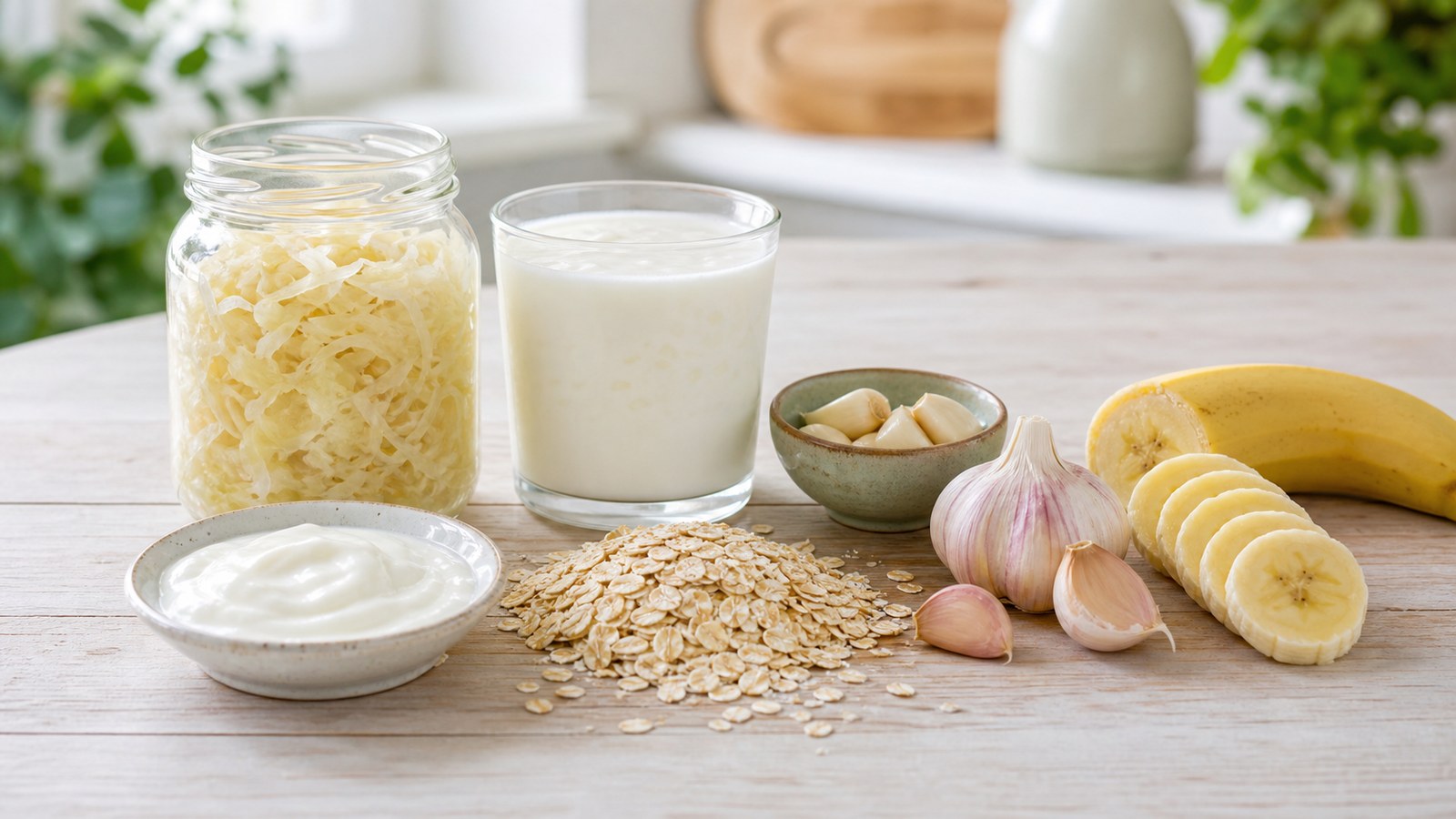
You get them two ways. The first is fermented foods — yogurt, kefir, traditionally fermented sauerkraut and kimchi, miso, and some cheeses. The second is supplements, which list specific strains (like Lactobacillus rhamnosus GG or Bifidobacterium lactis) and a dose in CFUs (colony-forming units).
Here's the part the marketing usually skips: effects are strain-specific. A benefit shown for one strain in one situation doesn't automatically apply to a different strain, or to "probiotics" as a vague category. So a label boasting "50 billion CFU" tells you about quantity, not whether that particular strain does anything for what you care about. The U.S. National Institutes of Health makes the same point — benefits depend on the specific strain and the use.2
Prebiotics flip the approach. Instead of adding new microbes, you feed the ones you already have. ISAPP defines a prebiotic as "a substrate that is selectively utilized by host microorganisms conferring a health benefit."3 In everyday terms, that's mostly certain fibers your own body can't digest but your gut bacteria can.
Common ones include inulin and fructooligosaccharides (FOS) in onions, garlic, leeks, and chicory root; galactooligosaccharides (GOS) in legumes; beta-glucans in oats and barley; and resistant starch in cooked-and-cooled potatoes, rice, and slightly green bananas. You don't need a supplement to get them — a varied, plant-heavy diet does the job, which is one reason "eat more different plants" is such durable advice.
A practical caution: if you ramp up prebiotic fiber too fast, the same fermentation that's the whole point can leave you gassy and bloated for a while. Going slow and drinking enough water makes the transition far more comfortable.
Postbiotics are the newest term and the most misunderstood. When your gut bacteria ferment prebiotic fiber, they produce a range of bioactive compounds — most notably short-chain fatty acids like butyrate, acetate, and propionate, which are a major fuel source for the cells lining your colon.
In 2021, ISAPP set a formal definition: a postbiotic is a "preparation of inanimate microorganisms and/or their components that confers a health benefit on the host."4 The defining feature is that postbiotics are not alive. That has a practical upside — non-living ingredients can be more shelf-stable and don't carry the same handling considerations as live cultures. The trade-off is that the human research base, while growing quickly, is younger and thinner than the decades of work behind probiotics.
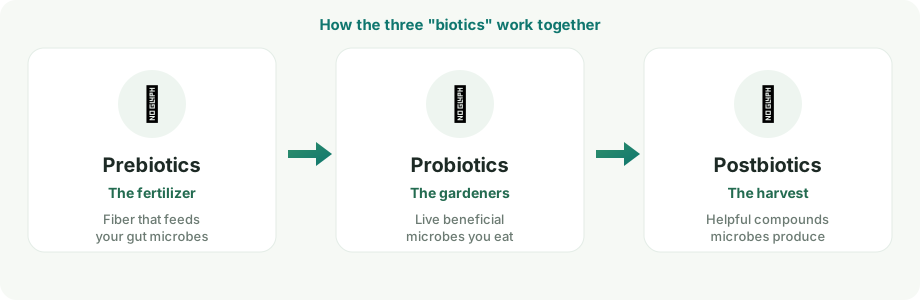
None of these works in isolation, which is exactly why they share label space. Prebiotics feed probiotics; probiotics (and your resident microbes) produce postbiotics. You'll also see synbiotics — products that deliberately combine a probiotic and a prebiotic so the food and the microbe arrive together.3
| Probiotics | Prebiotics | Postbiotics | |
|---|---|---|---|
| What it is | Live beneficial microbes | Fiber that feeds microbes | Compounds microbes produce |
| Alive? | Yes | N/A (it's food) | No |
| Food sources | Yogurt, kefir, kimchi, sauerkraut, miso | Onion, garlic, oats, beans, bananas, chicory | Made in your gut; also some fermented foods |
| Garden analogy | The gardeners | The fertilizer | The harvest |
| Evidence base | Largest, strain-specific | Strong, food-first | Newest, growing |
If you want one honest, low-cost place to begin, it's prebiotic fiber from food. It's gentle, it's cheap, it feeds the microbes you've already got, and the "eat more and more varied plants" message is about as close to consensus as gut science gets. Layer in a few fermented foods you genuinely enjoy, and you've covered probiotics and postbiotics at the same time without buying anything special.
Supplements can have a place — particularly specific probiotic strains studied for specific situations — but they're a targeted tool, not a substitute for the basics. If you're considering one, look for the named strain and the evidence behind that strain, and talk to a pharmacist or clinician if you have a health condition or take medication.
